
When God steps into our battles with a different agenda
Some moments in Scripture feel like mirrors. They reflect back to us the hidden assumptions we carry into our own struggles.
Joshua’s encounter near Jericho is one of those moments. It is a scene charged with tension, expectation and the weight of leadership. Joshua has crossed the Jordan. The people are finally in the land. The first great obstacle – the fortified city of Jericho – looms ahead.
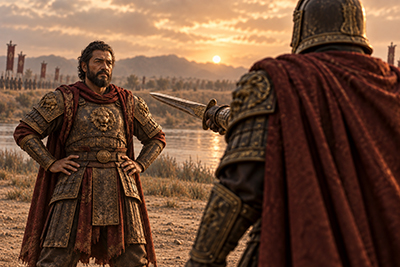
And then, unexpectedly, Joshua sees a man standing before him with a drawn sword. This is not a gentle vision. This is not a comforting sign.
This is confrontation.
Joshua does what any leader on the brink of conflict would do. He asks the most instinctive question a human heart can form in moments of pressure:
“Are you for us or for our enemies?”
It is a question we ask in countless ways.
- In conflict: Who is on my side?
- In leadership: Who will stand with me?
- In uncertainty: Whose support can I count on?
- In spiritual struggle: Is God backing my cause?
We want clarity. We want alignment. We want assurance that heaven is leaning in our direction. But the answer Joshua receives is not what he expects.
“Neither, but as Commander of the army of the Lord I have now come.”
With that single word - neither – God dismantles Joshua’s categories.
The God Who Refuses Our Sides
Joshua’s question assumes a world divided into two camps: us and them. It assumes that God must fit into one of those camps. It assumes that the upcoming battle is primarily about Israel’s victory.
But the Commander’s answer reveals a deeper truth: God is not a participant in human agendas. He is not a weapon we wield. He is not a banner we claim. He is not a silent partner in our plans, even when those plans seem righteous. God does not join our side. He invites us to join His.
This is unsettling because it means God cannot be domesticated. He cannot be reduced to a supporter of our causes, our preferences or our narratives. He stands above them – sovereign, free and utterly committed to His own purposes.
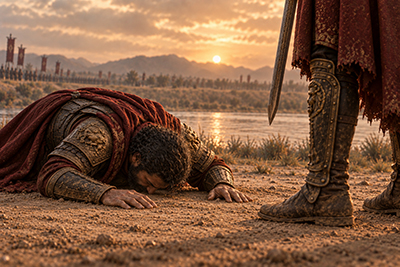
The Collapse of Joshua’s Posture
Joshua’s response is immediate and telling. He falls facedown. The posture of a commander shifts to the posture of a servant. The one who came asking questions now waits to receive instructions. His new question is the turning point:
“What message does my Lord have for his servant?”
This is the moment the real battle begins – not with Jericho, but within Joshua himself. Before any wall collapses, Joshua’s assumptions must collapse. Before he leads Israel, he must bow before God. Before he strategises, he must surrender. The fall of Jericho begins with the fall of Joshua’s pride.
The Danger of Assuming God is Automatically With Us
This passage exposes a subtle but dangerous spiritual instinct: the belief that God must be on our side because our intentions are good or our cause is noble.
We often assume:
- If I’m doing ministry, God must endorse it.
- If my motives are pure, God must support my plan.
- If I’m fighting for something righteous, God must be obligated to help me.
But the Commander’s “Neither” reminds us that God’s allegiance is never automatic. His purposes are larger than our programmes. His kingdom is not an extension of our ambitions.
Abraham Lincoln captured this truth with remarkable clarity: “My concern is not whether God is on our side; my greatest concern is to be on God’s side.”
The question is not whether God supports our plans. The question is whether our lives are aligned with His.
When God Interrupts Our Momentum
Joshua was ready for battle. He had momentum, clarity and a sense of divine calling. Yet God interrupts him at the threshold. Why? Because spiritual momentum without spiritual alignment is dangerous.
Sometimes God stops us not to discourage us, but to reorient us. Sometimes He disrupts our plans to protect us from ourselves. Sometimes He confronts us so that He can lead us more deeply.
Joshua needed to learn that the battle belonged to God long before the trumpets sounded. The victory would not come from military strength, strategic brilliance or human courage. It would come from obedience – strange, counterintuitive obedience.
The Invitation of the Commander
The Commander of the Lord’s army still stands before us in our own Jericho moments – the moments when we want God to take our side, bless our plans or validate our direction. Personally or even as communities and nations.
And He still says, gently but firmly:
“Neither.”
Not because He is indifferent. Not because He is distant. But because His purposes are deeper than our agendas, and His kingdom is larger than our categories.
He invites us to bow, to listen and to follow. The question is no longer, “Is God with me? The question becomes, “Am I with Him?”
Agree:The infinite sacred lies hidden in the minute; the human heart is mysterious and unpredictable; medicine requires the utmost refinement. Young leaders, do not ask whether God endorses your plans; learn and integrate the grand blueprint of “humanity and God working together” into the unknown of clinical practice. We are all chosen ones, and in His promise, we are transformed into a magnificent rainbow of red, blue, indigo, and violet, radiating a light that is eternal in a moment.